
Arriving in another country comes with many questions. And when you have children, those questions seem to multiply. One of the first is usually: “How do I enroll my child in school?”
Between the confusion of moving, the suitcases, temporary accommodation, family visits, deadlines, documents, school equivalencies, and so many new terms you may not even have known existed, it is completely normal to feel that everything is more complicated than it should be.
This article is a starting point to help you take a deep breath and understand that, although school enrollment can involve several steps, the process becomes less overwhelming when you have clear information on your side.
The goal here is not to cover every possible detail, because school enrollment may vary depending on the child’s age, grade level, country of origin, available documents, and even the time of year your family arrives in Portugal.
What I want to do is help you understand the general path of school enrollment in Portugal — from preschool to the 12th grade — so you can take the next step with more clarity.
Because when we move abroad with children, school is not just another piece of paperwork. It is one of the first doors through which the whole family begins to enter a new life.
How does the school system work in Portugal?
Before we talk about school enrollment, it is worth taking a moment to understand how the Portuguese school system is organized.
In general, education in Portugal is divided into the following stages:
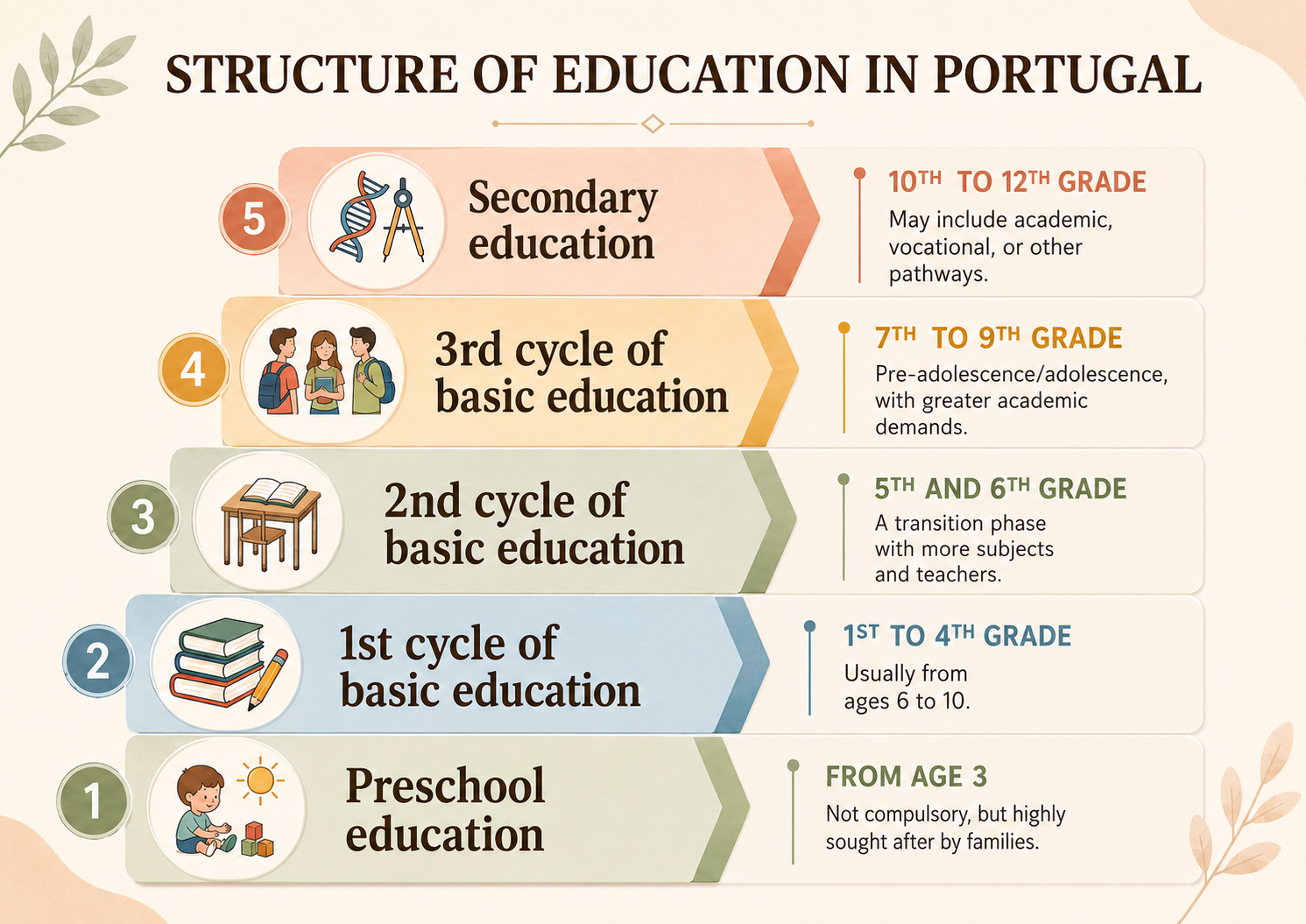
Although public preschool education in Portugal may accept children from the age of 3, in practice it is not always easy to find an available place at that age. In many areas, places tend to be assigned more frequently from the age of 4, depending on availability, demand, and the priority criteria used by each school cluster.
For immigrant families with young children, it is worth researching alternatives in advance, including IPSS institutions, private preschools, and options close to your future address.
Compulsory education in Portugal generally covers children and young people of school age. For this reason, it is important to contact the school or school cluster even if your family arrives outside the ideal enrollment period.
When to enroll your child in school in Portugal
School enrollments and renewals in Portugal follow deadlines defined each year.
For the 2026/2027 school year, for example, the official gov.pt website indicates the following enrollment periods: preschool and 1st grade from April 22 to June 1; 2nd, 3rd, 4th and 5th grades from July 1 to July 13; 6th, 7th, 8th, 9th and 11th grades from June 16 to June 29; and 10th and 12th grades from July 15 to July 22.
In simple terms, the ideal scenario is to check the official enrollment calendar every year and start preparing documents as early as possible, especially if your family is arriving from another country.
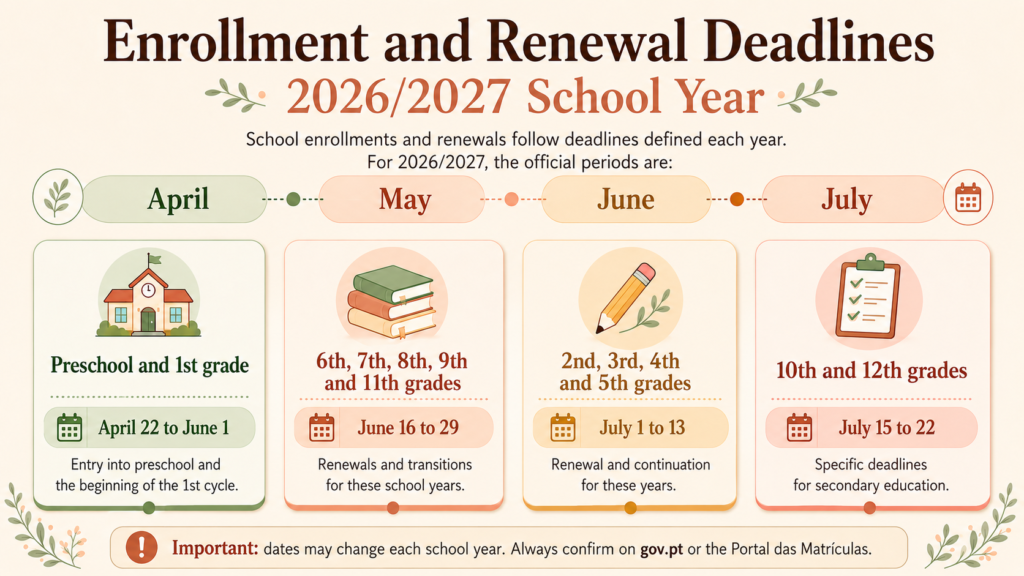
These deadlines may change from one school year to another. For this reason, before starting the process, always confirm the current dates on the Portal das Matrículas or on gov.pt.
And if your family arrived after the official deadline, take a deep breath. It does not necessarily mean your child will be left without a school place. It may simply mean that the process will be more manual, with visits to the school cluster and a little extra patience along the way.
Arriving after the deadline does not close the school door. Sometimes, it simply makes the path a little more manual — requiring more patience, presence, and guidance.
Where to enroll your child in school in Portugal
School enrollment can be completed through the Portal das Matrículas, the official platform for enrollment and renewal requests for preschool, basic education, and secondary education in Portugal.
To access the portal, you usually need to authenticate yourself using one of the accepted methods, such as Portal das Finanças login details, Chave Móvel Digital, or a Portuguese Citizen Card.
But many immigrant families arrive in Portugal before all of this is fully organized.
Maybe you do not have Chave Móvel Digital yet.
Maybe your NIF is still recent.
Maybe your address is still being sorted out.
Maybe you simply cannot access the portal yet.
In these cases, contact the main office of the school cluster in your area of residence. Many situations can be guided in person by the school or school cluster’s administrative office.
Here is a practical tip: bring everything you have, even if it is not perfect yet. Your child’s identification document, the parent or legal guardian’s document, proof of address, vaccination record, school records, and any document that may help the school understand your family’s situation.
Before moving: documents worth organizing in advance
Not everything starts on the Portal das Matrículas.
Some parts of school enrollment begin while you are still in your country of origin, when you organize school documents, vaccination records, and certificates that may be very important later.
If your child was already attending school in Brazil or in another country, try to bring:
-
the original school transcript or academic record;
-
a declaration of enrollment or attendance, if the child has not yet completed the school year;
-
a certificate or declaration of completion, when available;
-
documents with recognized signatures, when applicable;
-
school documents with a certifification, when required;
-
an updated vaccination record;
-
the child’s identification documents.
For Brazilian documents, it is common for schools and equivalency processes to pay close attention to legalization or authentication requirements. Since these requirements may vary, it is best to confirm them before traveling with the school in your country of origin and, if possible, with the school cluster in Portugal.
This is one of those things that may seem small before the move, but can save you a lot of stress later.
What if your child has already attended school outside Portugal?
When a child or teenager has already attended school outside Portugal, the Portuguese school may need to review previous school documents to understand which school year the child should be placed in.
This process is often referred to as the equivalency of foreign qualifications or placement in the appropriate school year. The gov.pt guide for migrants indicates that, for children and young people, Portuguese schools may handle the equivalency of foreign qualifications and/or integration into the appropriate school year and educational pathway.
In practice, this means that the school will look at your child’s previous academic path and try to place them within the Portuguese school system.
For Brazilian families, there is also an important point: Portugal and Brazil have approved a complementary agreement on the equivalence of studies. However, as with many administrative processes, it is wise to confirm with the school or school cluster how this is being applied at the time of enrollment.
My advice, from one mother to another: do not leave the equivalency process until the last minute. Even when everything goes smoothly, it can still bring anxiety to the whole family.
Documents commonly requested for school enrollment
The exact list may vary depending on the school, the school year, and your family’s situation, but it is usually helpful to have:
-
the child’s identification document;
-
the parent or legal guardian’s identification document;
-
the child’s NIF, if they already have one;
-
the parent or legal guardian’s NIF;
-
proof of address;
-
vaccination record;
-
school transcript or documents from the previous school;
-
an equivalency document or equivalency request, when applicable;
-
updated contact details for the responsible adults.
The parent or legal guardian is the person responsible for communicating with the school. In many cases, this will be the mother or father, but it may also be another legal guardian. This is the person who submits the enrollment request, receives school communications, and handles school-related matters.
After arriving in Portugal: health center, vaccines, and school insurance
In addition to school enrollment, there is another step that many families only discover once they are already in Portugal: registering the child at the health center in their area of residence and trying to obtain a Portuguese healthcare user number, known as the número de utente.
This number may be requested by the school or may make things much easier in situations involving healthcare, vaccinations, school accidents, and administrative procedures.
School insurance exists in Portugal and is linked to the protection of students within the school context. DGEstE identifies school insurance as being regulated by Portaria n.º 413/99 and connected to the enrollment and attendance system.
However, school insurance does not replace access to the healthcare system.
For this reason, even if the school enrollment process moves forward, it is worth dealing with the health center as soon as possible. It is also important to check whether your child’s vaccination record is up to date and aligned with the recommendations in Portugal.
This is one of those points where school, healthcare, and bureaucracy meet — and that is why it deserves attention early in the adaptation process.
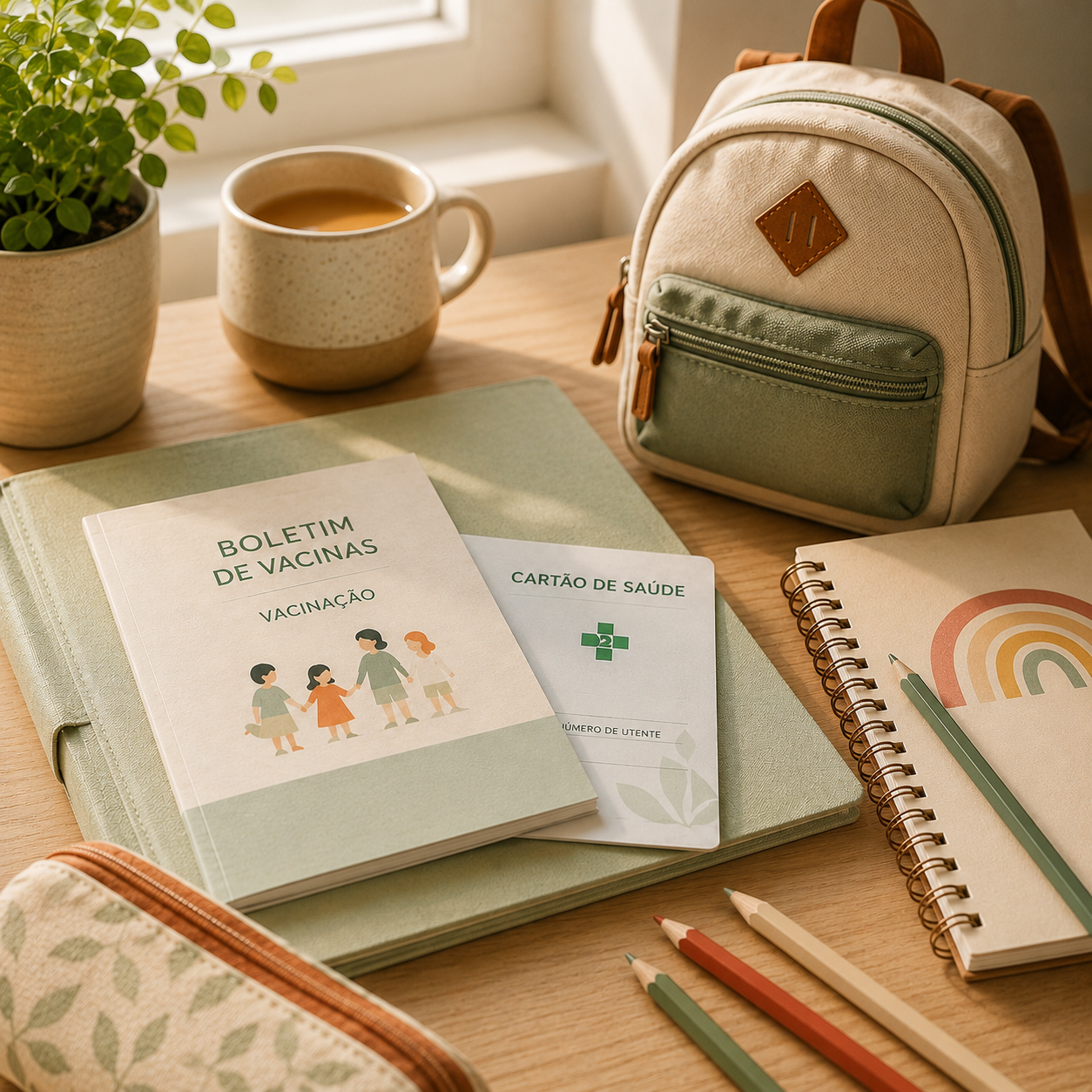
School enrollment does not end at the school door. When we arrive with children, healthcare, vaccines, and safety are also part of the adaptation journey.
School support in Portugal: meals, textbooks, and social assistance
In addition to enrollment itself, there is another topic worth understanding early on: school support.
In Portugal, these supports can help families with children enrolled in public education, mainly through Ação Social Escolar, usually known as ASE.
ASE places students into three support levels — A, B, and C — based on the family allowance bracket. This classification is reviewed every year and is connected to the household income and the value of the IAS, a topic that deserves its own article because it can raise many questions for families who have recently arrived in Portugal.
In simple terms: the lower the bracket, the higher the support the child usually receives.
Special situations
Some students may be automatically placed in bracket A in specific situations, such as:
-
students with support measures for learning and inclusion;
-
students living in institutional care;
-
students included in the refugee contingent.
As these rules may change or be updated, it is always worth confirming directly with the school cluster at the time of enrollment or renewal.
School meals
School meals are available to all children and students, regardless of their ASE bracket. What changes is the amount paid.
For the 2025/2026 school year, the base price of a school meal is €1.46, and an additional amount may apply, for example €0.30, when the meal is booked on the same day.
This is one of those practical details that many families only discover once the school routine begins. For this reason, it is worth asking the school how meal bookings work, which platform is used, and what the deadlines are for booking or canceling lunch.
In addition to lunch, other forms of support may also exist:
-
breakfast: free for students in bracket A during the school year;
-
meals during school breaks: during the Christmas and Easter breaks, some schools continue to provide meals to students who benefit from ASE, upon prior request.
In practice, this can make a difference to the family budget, especially during the first months of adaptation, when you are still trying to understand how everything works.
Free school textbooks: the MEGA Program
Another important support is free school textbooks, provided through the MEGA Program.
This program covers students from 1st to 12th grade and works through vouchers issued by the school and made available on the MEGA Platform.
Parents or legal guardians must register on the platform or through the Edu Rede Escolar app, usually using their NIF and Portal das Finanças login details.
Each voucher has a unique code or QR Code and allows families to collect the textbooks assigned for the child’s school year. In some cases, the voucher may indicate new books, which should be collected from a participating bookshop. In other cases, it may indicate reused textbooks, which should be collected directly from the school.
There is an important point here: free school textbooks do not mean that all school supplies will be free.
Activity books, exercise books, complementary learning materials, notebooks, pencils, backpacks, and other materials requested by the school are usually not included in this program.
For this reason, even with textbook vouchers, it is wise to set aside some budget for the additional materials that are commonly requested at the beginning of the school year.
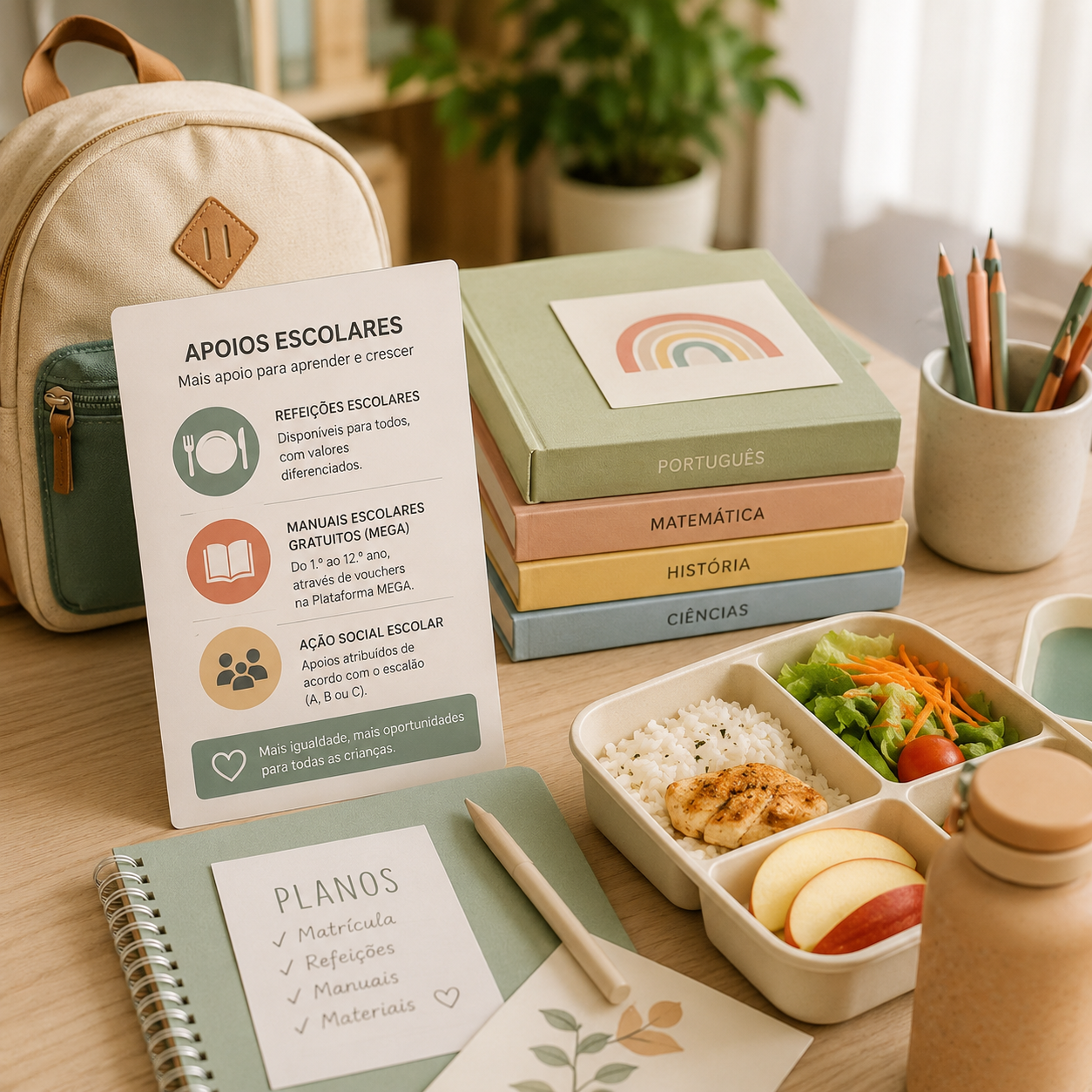
School support can make a real difference, but it does not always cover everything. Asking questions early, confirming deadlines, and understanding what is included can help your family start the school year with fewer surprises.
European Portuguese, school adaptation, and PLNM support
For Brazilian children, language may seem like a smaller concern at first. After all, we speak Portuguese. But adapting to European Portuguese can still be surprising.
The vocabulary changes.
The accent changes.
Expressions change.
Even the way teachers explain things may feel different.
For children from countries where Portuguese is not their native language, or was not the language used at school, support may be available through Português Língua Não Materna, known as PLNM — Portuguese as a Non-Native Language.
For Brazilian children, the challenge is often less about formal language and more about adapting to the vocabulary, accent, rhythm of the school, and local culture.
So even when your child already speaks Portuguese, pay attention to the signs.
Do they understand the instructions?
Can they follow the lessons?
Are they embarrassed to speak?
Are they making friends?
Do they feel out of place?
Enrollment is only the beginning. School adaptation continues long after the child walks through the school door.
What changes at each school stage
School enrollment does not carry the same emotional and practical weight at every age.
A child entering preschool needs a different kind of adaptation from a child starting the 1st cycle. A student moving into the 2nd cycle begins to deal with more teachers and more subjects. In the 3rd cycle, the social side of school can become especially important. In secondary education, choices about academic paths, subject equivalencies, and future expectations also come into play.
For this reason, this article is only a general overview.
Later, it is worth looking more carefully at each stage:
-
preschool enrollment;
-
enrollment in the 1st cycle;
-
enrollment in the 2nd cycle;
-
enrollment in the 3rd cycle;
-
enrollment in secondary education.
Each stage brings its own questions. And each child experiences the move in their own way.
What if your preferred school has no available places?
Depending on the area where you choose to live, there may be no available place in the school year your child needs, especially in areas with higher demand.
If this happens, take a deep breath. Not finding a place at the first school does not mean your child will be left without studying.
The first step is to try enrolling your child in other schools within the same school cluster or in the surrounding area that offer the required school year, even if they are not exactly the schools linked to your home address or workplace. The full list of schools in the cluster can be checked on the Portal GesEdu.
If all the schools you contact indicate that there are no available places, the next step is to contact DGEstE — the Directorate-General for Schools.
DGEstE is responsible for following these situations and helping ensure that children of school age are assigned a school place. In these cases, the recommended contact is:
atendimento.dsrlvt@dgeste.mec.pt
When writing to them, explain the situation clearly. Include your child’s age and school year, your home address, the schools you have already contacted, and, if possible, attach or mention the responses you received.
The process may require some persistence and patience, but it is important to know that there is an official body responsible for coordinating the assignment of a school place when local schools cannot solve the situation directly.
Do not leave the situation simply “on hold.” Keep a record of your contacts, save the replies you receive, and contact DGEstE if you realize you are not finding a solution through the schools.
School enrollment is a doorway into a new life
School enrollment is one of the first major steps in the life of an immigrant family in Portugal.
And it brings everything together at once: documents, deadlines, homesickness, fear, hope, adaptation, and that deep desire to make things work for our children.
You do not need to understand everything all at once.
Start with the school stage your child is in.
Check the official deadlines.
Organize the documents you can.
Contact the school cluster in your area.
Ask about vaccines, the número de utente, school insurance, and available support.
And above all, pay attention to how your child is feeling emotionally.
Because enrolling a child is not just about placing them in a school.
It is about helping them find a possible place within a new life.
School enrollment is more than a completed form. It is one of the first doors that opens for a child to begin feeling that this new life can also belong to them.
Now I’d love to hear from you: what was this process like for your family? What was the biggest challenge you faced when enrolling your child in school?



Comentários